








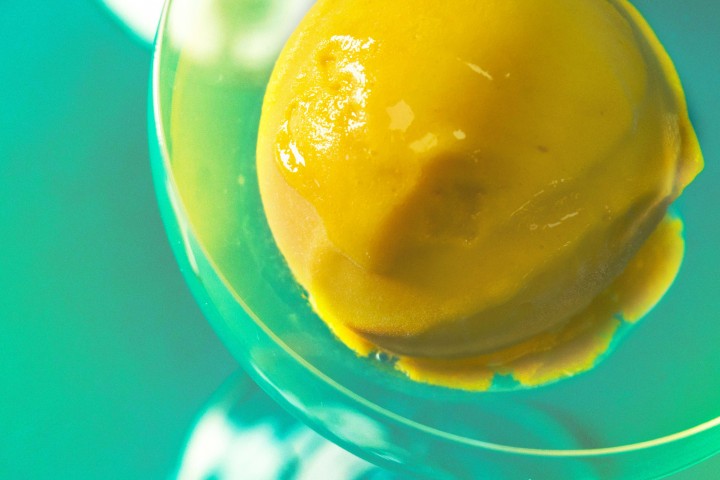
Creating a great sorbet is all about finding the right balance between fruit, sugar and water content for a perfect texture. With the right base, you can create smooth, soft-scooping sorbets from a wide range of fruits and then customise them further with additional flavours. We use our Sorbet Stabiliser to create a simple base that can be adapted depending on the fruit and flavour profile you're working with.
Watch the Demonstration
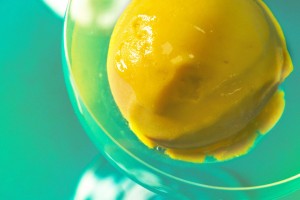
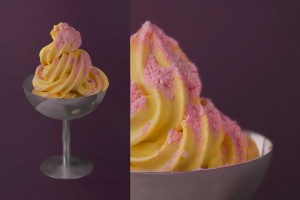
Chef Rupert demonstrates how to create peach sorbet and rhubarb sorbet using MSK Sorbet Stabiliser and processed in a FRXSH Mousse Chef. See how the same approach can be adapted to different fruits while maintaining a smooth, creamy and soft-scooping texture.
Standard Sorbet Recipe
Ingredients
- 600g fruit puree
- 400g water
- 150g sugar
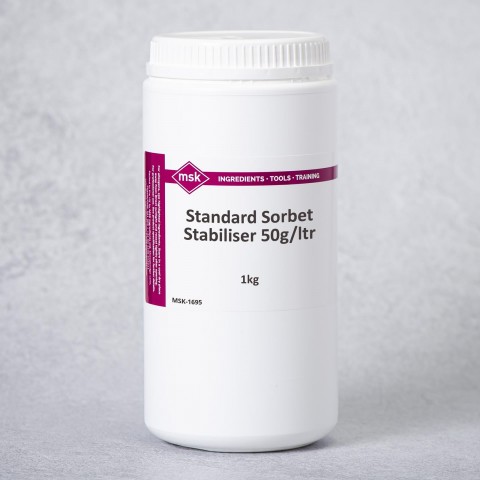
- 50g Standard Sorbet Stabiliser
- pinch of Malic Acid
Method
In a bowl, stick blend together the fruit puree, water, sugar and sorbet stabiliser.
Add the malic acid to taste and blend again to combine.
Pour into a canister and freeze until solid.
Process in the frozen dessert processing system and serve.
Peach Sorbet Recipe
Ingredients
- 500g peach puree
- 75g water
- 100g sugar
- 50g Standard Sorbet Stabiliser
- pinch of Malic Acid
Method
In a bowl, stick blend together the peach puree, water, sugar and sorbet stabiliser.
Add the malic acid to taste and blend again to combine.
Pour into a canister and freeze until solid.
Process in the frozen dessert processing system and serve.
Take the Base Further: Flavour Variations
Once you've established your fruit base, there are plenty of ways to develop the flavour further. Additional flavour ingredients can be used to introduce complementary fruit, floral, botanical and more unusual flavour profiles.
For example, a peach sorbet can become:
Peach and Lemon Verbena with Lemon Verbena Flavour Burst.
Peach and Vanilla with Vanilla Flavour Drops or Vanilla Flavour Burst.
Peach and Jasmine with Jasmine Flavour Drops.
Peach and Raspberry with Raspberry Flavour Drops.
Peach and Amaretto with Amaretto Flavour Burst.
This approach means one base recipe can become the starting point for multiple finished flavours, without needing to completely reformulate each time.
Notes
Both of these recipes are best for high-performance frozen-dessert processing systems but can be made in traditional churning machines.
Related Products

Leave a Comment